
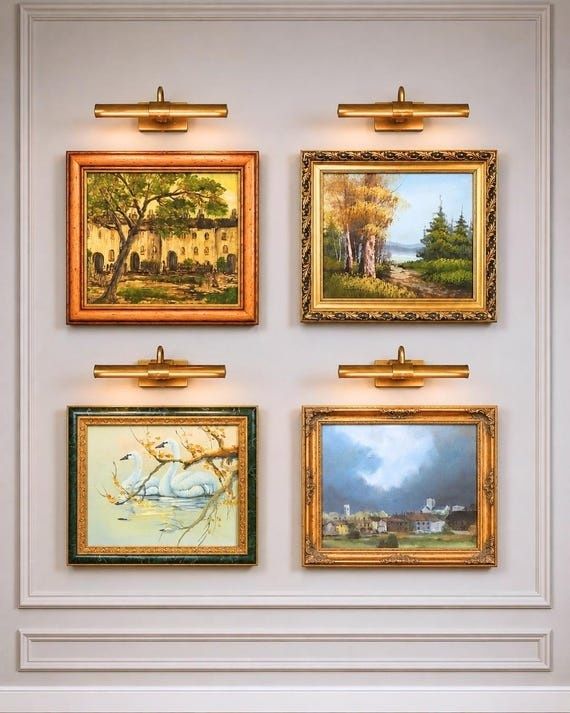
Why Everyday Ambient Light Flattens Great Art
A finely made painting can contain an extraordinary range of information: the raised ridge of an impasto stroke, the transparent warmth of a glaze, the cool retreat of a shadow, or the delicate tooth of paper beneath a wash. Yet standard residential illumination rarely allows those qualities to emerge. A central ceiling fixture is designed to distribute general brightness, not to interpret a surface. Its broad, undirected output often creates competing reflections, uneven hotspots, and a visual field in which the artwork becomes merely another object in the room.
This is the central difference between ambient lighting and a curatorial approach. Gallery-grade illumination treats light as part of the presentation, alongside scale, framing, wall colour, and viewing distance. A carefully positioned, high-quality source can reveal the artist”s intended palette and give texture a controlled presence without turning every raised mark into a harsh shadow. For collectors considering gallery-style art lighting, the objective is not simply to make a picture brighter. It is to create a measured viewing environment that enhances visual character while limiting unnecessary exposure.
The Science of Color Fidelity Across CRI and TM-30 Standards
Colour fidelity begins with the light source itself. The familiar Colour Rendering Index, or CRI, remains a useful first filter, particularly when selecting fixtures rated CRI 90 or higher. However, CRI is an imperfect measure. It averages performance across a limited group of colour samples and does not fully explain how a lamp handles saturated colours or how its spectrum affects the overall character of an artwork. Two sources can share a high CRI rating while producing noticeably different results on a painting.
The Illuminating Engineering Society”s TM-30 system offers a more informative assessment. Its fidelity score, Rf, describes how accurately colours are rendered relative to a reference source, while its gamut score, Rg, indicates whether colours appear more muted or more saturated. TM-30 also considers a broader range of colour samples, making it particularly useful when evaluating complex palettes. For a serious collection, ask manufacturers or lighting designers for TM-30 data rather than relying on CRI alone.
Deep red rendering deserves special attention. The R9 value, which is not included in the conventional CRI average, indicates performance with saturated reds. A weak R9 can make vermilion, crimson, terracotta, burgundy, and flesh tones appear lifeless. That matters in oil portraits, warm glazes, still lifes containing fruit or textiles, and even dark mahogany frames. High R9 performance helps preserve the subtle relationships between red, orange, brown, and neutral tones that often give a composition its emotional temperature.
- Choose a minimum CRI of 90, with CRI 95 or higher preferred for important works.
- Request TM-30 values, particularly Rf and Rg, when comparing premium LED sources.
- Look for strong R9 performance if the collection includes portraits, warm glazes, or saturated reds.
- Use dimmable fixtures so brightness can be tailored to the room, surface, and viewing distance.
Residential colour temperatures between 2700K and 3000K generally provide a warm, composed atmosphere that suits many oil paintings, traditional frames, and domestic interiors. A 2700K source can enrich umbers, ochres, and red-based palettes, while 3000K introduces slightly greater clarity without making the room feel clinical. Higher temperatures may be appropriate in a contemporary space or for a work dominated by cool whites and blues, but overly cool light can make warm pigments appear disconnected and may cause whites to look unnaturally blue. The correct choice should respond to the artwork”s palette as well as the surrounding architecture.
Mastering Beam Geometry and the Thirty Degree Angle
The widely used museum principle of aiming light at approximately 30 degrees from the vertical plane of the artwork is a practical starting point. At this angle, the beam reaches the surface with enough direction to reveal texture while reducing the likelihood of a direct reflection returning toward the viewer. It also limits the long, dramatic shadows that can result from a very steep side angle. Position remains as important as fixture quality: a technically excellent lamp can still fail if it is mounted too close, aimed too directly, or aligned with a glossy surface.
Beam spread should correspond to the scale and surface of the work. A narrow beam can create presence around a small, richly textured painting, but it may produce a distracting hotspot on a larger canvas. Heavy impasto benefits from oblique, carefully softened illumination that allows the ridges to register without fragmenting the image. Varnished paintings and glazing require particular care because a narrow beam may reflect with blinding intensity. Adjustable optics, anti-glare accessories, museum glass, and a slight downward adjustment can preserve visibility while maintaining visual drama.
| Artwork and frame scale | Typical optical spread | Indicative illuminance |
|---|---|---|
| Small work up to 60 cm wide | 10 to 20 degrees | 50 to 100 lux |
| Medium work from 60 to 120 cm wide | 20 to 30 degrees | 75 to 150 lux |
| Large work above 120 cm wide | 30 to 40 degrees | 100 to 200 lux |
| Highly sensitive works on paper | Broad, diffused spread | 30 to 50 lux |
These lux ranges should be treated as planning references rather than universal prescriptions. Conservation requirements vary according to pigment stability, medium, framing, and exhibition duration. A light meter placed at the artwork”s surface is more reliable than judging brightness from the room. The visual aim is an even field with sufficient modelling, not maximum output.
Choosing Between Picture Lights, Framing Projectors, and Track Systems
Dedicated picture lights offer a particular intimacy. Mounted above the frame, they become part of the furniture and architecture, which can suit historic interiors, libraries, dining rooms, and rooms where a visible fitting contributes to the atmosphere. Their limitation is precision. A fixed or poorly adjusted picture light may illuminate the upper section more strongly than the lower section, and its reflection can become apparent on glass or varnish. Select a model with a shielded source, adjustable direction, dimming capability, and dependable colour quality.
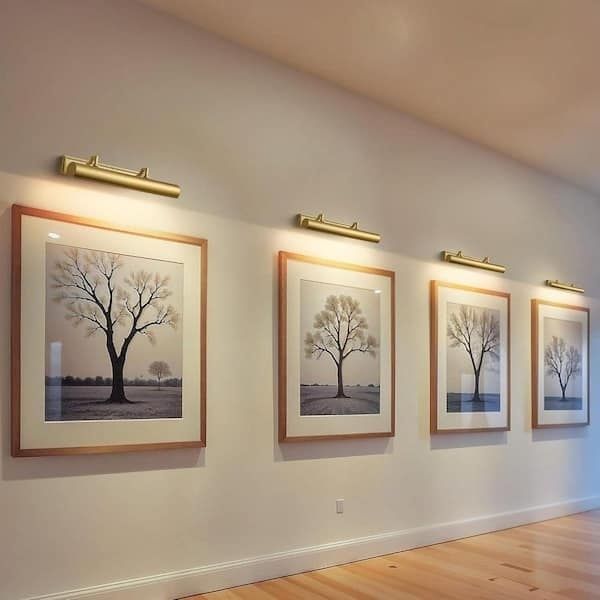
A useful proportional rule places the picture light at roughly one-half to two-thirds of the frame width. This keeps the fixture visually subordinate while giving its beam sufficient reach across the image. Measure the outside width of the frame, not just the paper or canvas. A 36-inch frame, for example, may suit a light between 18 and 24 inches wide. Tall works may require greater projection or an adjustable arm, while very wide panoramas may need two coordinated fixtures rather than one oversized fitting.
Ceiling-mounted track heads, framing projectors, and recessed adjustable fixtures offer greater control for contemporary rooms and evolving collections. A framing projector can shape the beam to the exact perimeter of a work, reducing spill onto the wall and creating a particularly composed presentation. Track systems are valuable when several works must be lit independently, since each head can be aimed, dimmed, and repositioned as the collection changes. Hardwired installations provide a discreet, permanent result and suit new construction or major renovation. Wireless, plug-in, or battery-operated picture lights are less invasive and can be preferable in listed buildings, rented properties, or rooms with delicate panelling.
- Use a picture light when the fixture should participate in the room”s decorative language.
- Choose a framing projector when a precise perimeter and minimal wall spill are priorities.
- Select an adjustable track system for gallery walls, changing displays, or mixed media.
- Specify LED sources with high colour quality and low heat, especially for works behind glazing.
Preserving Pigments Against Thermal and Photochemical Decay
Light damage is cumulative. It is governed not only by the intensity of illumination but also by the length of exposure, commonly considered in lux hours. Watercolours, dyes, many works on paper, and certain photographic processes are especially vulnerable and may require illumination around 30 to 50 lux. More stable oil paintings can often tolerate higher levels, but “durable” does not mean immune. Sensitive pigments can fade gradually even when the change is too subtle to notice from one season to the next.
Legacy halogen fixtures create additional concerns. Their infrared output can raise the temperature near the artwork, while older lamps may also emit ultraviolet radiation unless properly filtered. Heat can accelerate chemical reactions in coatings, adhesives, and supports, particularly inside poorly ventilated frames. Modern museum-grade LEDs generally offer much lower UV and infrared output, although product specifications and installation quality still matter. Direct sunlight remains one of the most difficult conditions to control because it combines intensity, ultraviolet exposure, heat, and changing angles throughout the day.
- Measure the artwork”s actual lux level with a calibrated light meter, checking the brightest area rather than relying on the dimmer position.
- Install UV-filtering glazing, shades, blinds, or solar-control film wherever daylight reaches the work.
- Replace legacy halogen fixtures with low-heat, high-colour-quality LED sources and verify that the fitting does not trap heat behind the frame.
- Set a daily lighting schedule and reduce output for works on paper, watercolours, textiles, and photographs.
In naturally lit rooms, the most responsible solution is layered control. Daylight can be welcomed for general atmosphere while the artwork remains protected by diffusion, filtration, and distance from windows. Automatic blinds and occupancy controls can reduce unnecessary exposure, but they should not replace periodic inspection. Check for changes in paper tone, fading along exposed edges, yellowing varnish, or localised heat. For historically significant or exceptionally sensitive pieces, a conservator or lighting designer familiar with museum practice should establish the exposure limits.
Transform Your Collection with Curatorial Precision
Effective art lighting brings together three disciplines: optical control, colour accuracy, and conservation. A well-chosen source reveals the movement of a brushstroke and the quiet complexity of a glaze, while an appropriate beam angle prevents glare from interrupting the image. Measured lux levels and low-heat, low-UV equipment then ensure that the visual reward does not come at the expense of the object”s future.
Begin with an audit rather than an immediate purchase. Measure current illumination at the artwork, inspect reflections from the principal viewing position, and compare the appearance of key colours under the existing fixture and a high-quality reference source. Record the frame dimensions, medium, glazing, and exposure to daylight. From there, one focused adjustment, such as replacing a cool ceiling lamp with a dimmable 3000K LED track head aimed at 30 degrees, can turn a flat display into a considered installation with gallery-grade presence.