
The Allure of the Singular Impression
Among the many forms of original art on paper, the monotype occupies an unusually compelling position. It is created through a printing process, yet it behaves with the freedom of painting. Pigment can be brushed, rolled, wiped, dragged, or allowed to pool across a smooth plate before a sheet of paper is placed over it and pressure draws the image into being. For collectors seeking original works on paper, that combination of immediacy and technical discipline offers a distinctive kind of presence. No two impressions can be perfectly repeated, and the resulting image often retains evidence of the hand, the plate, the paper, and the pressure that joined them.
The medium contains a productive historical paradox. A monotype is conceived on a printing press, an instrument traditionally associated with multiples, editions, and repeatable images, but it generally yields only one fully realized impression. That singularity makes it neither simply a painting nor an ordinary print. It is instead a record of an encounter between intention and resistance, where a carefully considered composition may be altered by absorption, viscosity, pressure, and chance. For contemporary collectors and interior decorators, this means acquiring a work with painterly texture, immediate mark-making, and a scarcity that is intrinsic to its making rather than manufactured by a limited-edition number.
Demystifying Monotype Versus Monoprint
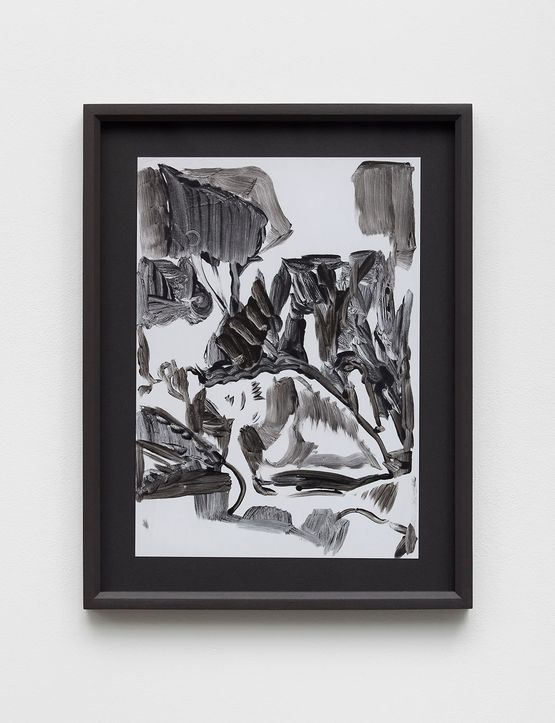
The terms monotype and monoprint are frequently used interchangeably in galleries, studios, and online listings, although they describe different relationships between image and matrix. A monotype is generally made from a smooth, unetched plate, often of metal, acrylic, or another nonabsorbent material. The artist creates the entire image directly on that surface and transfers it once to paper. Because there is no fixed image to repeat, the work stands as a singular composition.
A monoprint, by contrast, contains a persistent element that can appear across a sequence of impressions. That element may be an etched line, a drypoint mark, a collagraphic texture, or another fixed feature in the matrix. Additional layers of wiped ink, painted color, stencils, or collage can change from one impression to the next, making every print distinct while retaining a recognizable structural relationship. The distinction is explained clearly in discussions by printmaking practitioners and in studio teaching that combines drypoint with painterly monotype methods.
| Characteristic | Monotype | Monoprint |
|---|---|---|
| Matrix | Smooth and unetched, with no permanent image | Contains a fixed element such as drypoint, etching, or texture |
| Repeatability | Designed as a single, unrepeatable impression | Can form a varied series around a recurring matrix feature |
| Edition status | Usually unique and not conventionally editioned | May belong to a sequence, although each impression varies |
| Surface character | Painterly, fluid, and highly responsive to wiping and pressure | Combines repeatable structure with changing color, tone, and gesture |
For buyers, the terminology matters because it clarifies what is being acquired. A unique monotype should be catalogued as an original impression, not treated as a reproduction simply because a press was involved. A monoprint may also be a highly original work, but its relationship to related impressions can influence provenance, pricing, and the way a gallery presents it. Asking whether the plate contains a permanent image, whether related impressions exist, and how the artist describes the process provides useful clarity before purchase.
The Chemistry of Pressure and Spontaneity
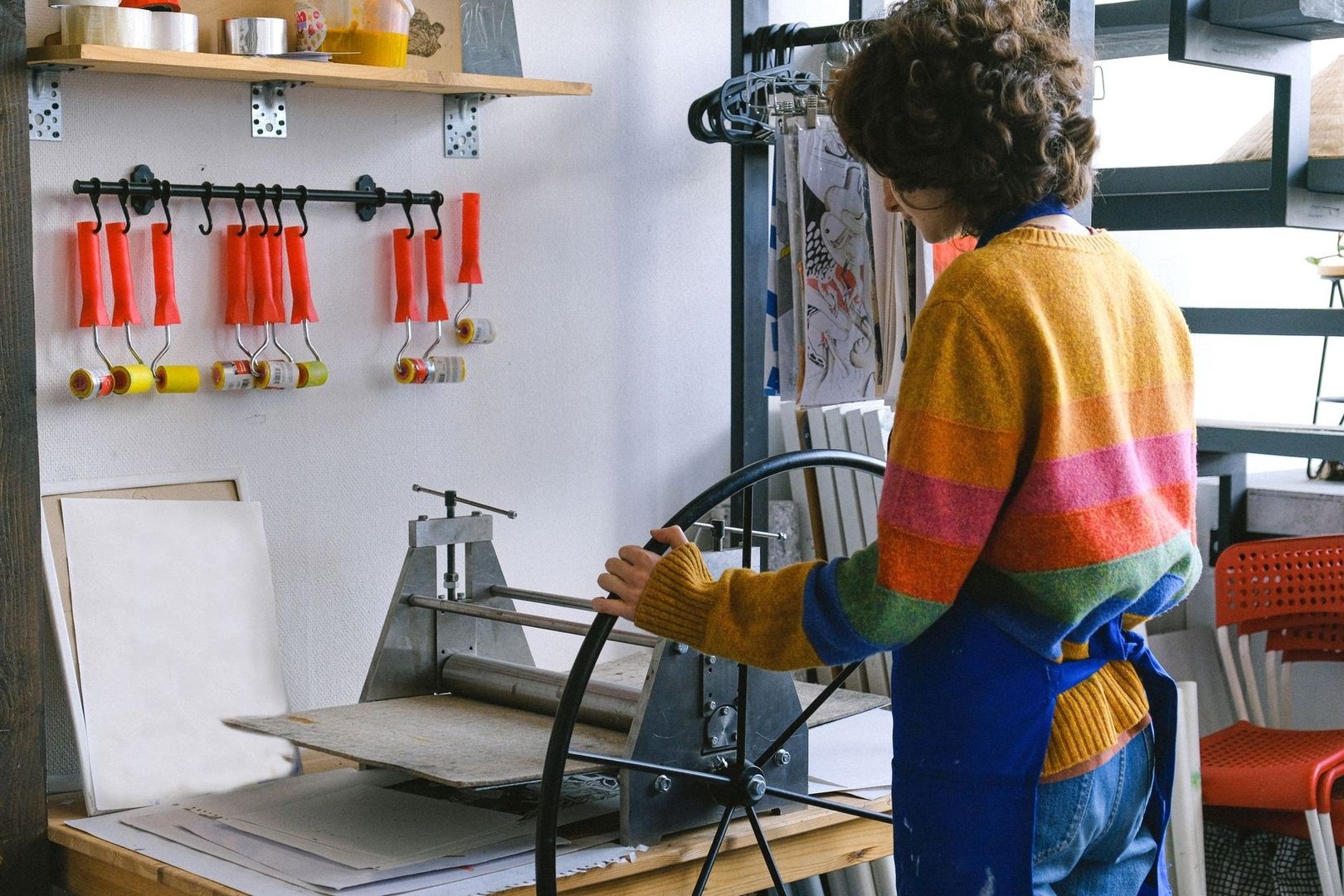
The making of a monotype is intimate and physical. The artist applies oil-based ink, water-based pigment, or paint to a smooth plate, then manipulates the surface before the paper is introduced. A dampened cotton rag sheet may be laid carefully over the plate and passed through an etching press. Pressure forces the paper into contact with the pigment, drawing out not only the broad image but also subtle changes in density, edges, drag, and absorption. As technical accounts of original printmaking explain, the transfer itself is central to the medium: the image is not merely painted, but realized through pressure from a matrix onto paper.
Artists can work additively by placing ink onto the plate with a brush, roller, sponge, or other tool. They can also work subtractively, beginning with an inked field and removing pigment with rags, cotton swabs, cards, or fingertips. Wiping creates passages of light, while dragging produces atmospheric trails and broken contours. Uneven pressure can leave halos around forms, particularly where ink gathers at the perimeter of a gesture. These organic borders are not imperfections to be corrected; they are among the qualities that distinguish a monotype from a mechanically reproduced image.
- Additive marks build form through painted, rolled, brushed, or stencilled pigment.
- Subtractive marks reveal light by lifting ink from the plate.
- Pressure variations alter saturation, softness, and the sharpness of edges.
- Surface materials such as fabric, leaves, cardboard, or collage elements can introduce unexpected textures.
The medium has attracted artists precisely because it permits disciplined improvisation. Adolph Gottlieb”s late monotypes are a particularly moving example. Between 1973 and 1974, he made 54 unique works while revisiting concerns that had shaped his career, including polarity, balance, color, and spatial tension. According to the Adolph and Esther Gottlieb Foundation, the works allowed him to engage directly with paint and paper while the press helped document the unfolding of his ideas. Each impression became both finished artwork and evidence of artistic thought in motion.
Sometimes enough pigment remains on the plate to produce a faint second pull, commonly called a ghost impression. It is usually paler and less defined than the first transfer, but it can possess a fragile atmosphere of its own. The ghost is not normally regarded as an equal repeat of the original; rather, it records the residue of the first act and the artist”s decision about whether to develop, alter, or abandon it. For collectors, such a work can reveal iteration with unusual directness, showing how an artist responds to what the press has already made visible.
Market Scarcity and the Connoisseurship of Works on Paper
Monotypes appeal to institutions and discerning private collectors because their uniqueness is inseparable from their technique. A conventional print edition may offer multiple impressions with shared visual information, while a monotype documents a single moment of decision and transfer. This does not automatically make every monotype rare or valuable, but it does give the category a strong foundation for connoisseurship. The collector is not simply purchasing an image; the purchase encompasses the artist”s handling of ink, the choice of paper, the physical behavior of the plate, and the evidence of a process that cannot be duplicated exactly.
Pricing often places monotypes between established editioned prints and paintings on canvas, although the range is broad. Artist reputation, date, scale, condition, provenance, exhibition history, and technical ambition all influence value. A monotype by a recognized modern or contemporary artist may command substantially more than a studio experiment by an emerging practitioner, yet the medium can still provide access to significant artistic practices at a lower price than a comparable unique painting. Collections such as the William and Sara Hall Collection at the University of Alabama demonstrate how serious print collecting can encompass both internationally known artists and lesser-known makers, while preserving evidence of technical craftsmanship and professional print culture.
Before acquisition, close looking should accompany any discussion of price. Examine the work under suitable light and ask the gallery for a condition report, documentation of the process, and confirmation of the artist”s signature. The following details deserve particular attention:
- Paper quality: Heavy cotton rag paper should feel substantial and should be free from distracting stains, severe distortion, or embrittlement.
- Ink saturation: Dense passages should remain richly layered, while delicate areas should retain tonal variation rather than appearing uniformly faded.
- Plate indentation: A visible embossed edge can confirm that the sheet passed through a press, although its absence does not by itself invalidate a work.
- Signature and documentation: Compare the signature with authenticated examples and request provenance, exhibition records, or a certificate where appropriate.
- Condition: Look for abrasion, transferred ink, foxing, tears, stains, and evidence of unsuitable previous framing.
Contemporary visibility also matters. Print studios, artist residencies, gallery exhibitions, and public events such as the Center for Contemporary Printmaking”s MONOTHON bring unique impressions before new audiences. These settings can reveal how established artists, emerging printmakers, and master printers collaborate in real time. Institutional exhibitions and curated platforms devoted to editions and multiples further demonstrate that works on paper are not secondary objects, but an important field of contemporary artistic research.
Curation and Conservation Essentials for Collectors
Monotypes are often made on robust rag paper, but the image layer can remain vulnerable to light, abrasion, pollutants, and unstable humidity. Oil-based inks may require careful handling, while thinly applied passages can be especially sensitive to rubbing or contact with glazing. The paper”s deckled edges, plate mark, and irregular margins are part of the object”s character, so framing should protect those qualities without flattening or concealing them. Conservation-minded instruction in printmaking, including programs such as Mt. SAC”s printmaking curriculum, underscores how material knowledge and craftsmanship remain inseparable from the finished work.
For residential display, avoid placing a monotype where direct sunlight reaches the sheet for extended periods. Stable conditions are preferable to dramatic fluctuations, particularly near radiators, fireplaces, kitchens, bathrooms, or exterior doors. Gallery lighting should be measured and restrained, with UV filtering wherever possible. A work on paper does not need to be hidden away, but it should be treated as a sensitive original object rather than as a decorative poster.
- Choose museum glazing with strong ultraviolet filtration and low reflectivity, especially for rooms with windows or bright artificial light.
- Use an acid-free, archival mat to keep the paper safely separated from the glazing and to reduce the risk of acidic migration.
- Request conservation mounting using reversible hinges or another appropriate archival method, rather than permanent adhesives.
- Consider float mounting when the deckled edges, plate indentation, or irregular margins are important to the visual experience.
- Allow breathing room around the sheet and use a properly sealed frame package to reduce exposure to dust and pollutants.
Float mounting is particularly effective in contemporary interiors because it presents the full sheet as an object with physical margins, not merely as an image inside a rectangle. The generous space around a small or medium-sized monotype can intensify its intimacy, while a larger work may anchor a room through the contrast between a quiet paper ground and energetic, tactile marks. The frame should support the work”s scale and palette without competing with it.
Building an Enduring Collection with One-of-a-Kind Impressions
Monotypes bring a rare kind of intimacy into a collection. Their visual language may be spare or exuberant, but the surface often retains a palpable record of touch: a wiped passage, a soft halo, a compressed edge, or a sudden interruption where the press transformed wet pigment into a finished image. That material immediacy allows a monotype to hold its own in a carefully curated room, whether displayed beside paintings, grouped with other works on paper, or given a quiet wall where its subtleties can unfold.
The most rewarding discoveries often come through print studios, open-press events, artist talks, specialized auctions, and galleries with a serious commitment to contemporary printmaking. Emerging artists may offer technically adventurous work before wider recognition changes the market, while established practitioners can reveal unexpected dimensions of their practice through the medium. Select works that demonstrate both technical command and emotional resonance. A monotype earns lasting significance not only through its rarity, but through the quality of attention it invites each time the room falls quiet around it.