
Rediscovering Texture in the Modern Living Space
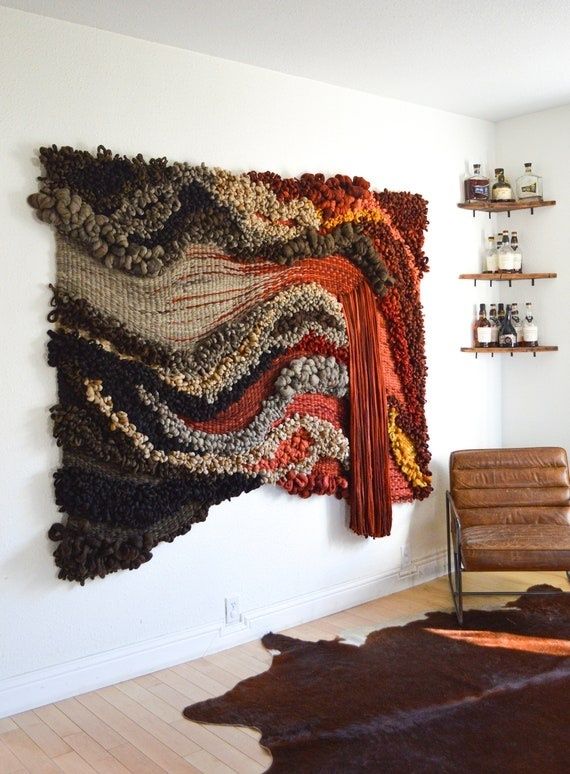
Contemporary architecture often prizes visual restraint: uninterrupted planes of concrete, expanses of glass, sharply drawn steel, and furniture reduced to essential geometry. Yet the serenity of minimalism can become overly polished when every surface reflects rather than absorbs. Against this condition, collectors and designers are returning to works that invite the eye to linger and the hand to imagine contact. Dimensional fiber art answers that desire with density, movement, irregularity, and visible evidence of making.
Unlike a flat textile hung as a discreet accent, a sculptural weaving occupies space with genuine presence. Its loops, ridges, fringes, and projecting bands alter as daylight moves across the room. In a residence defined by hard planes, woven fiber establishes an intimate spatial dialogue, softening transitions without sacrificing architectural clarity. The strongest works do not merely decorate steel, concrete, and glass; they mediate between them, bringing an atmosphere of human scale and material warmth into the modern living space.
The Architectural Balance Between Soft Fiber and Hard Planes
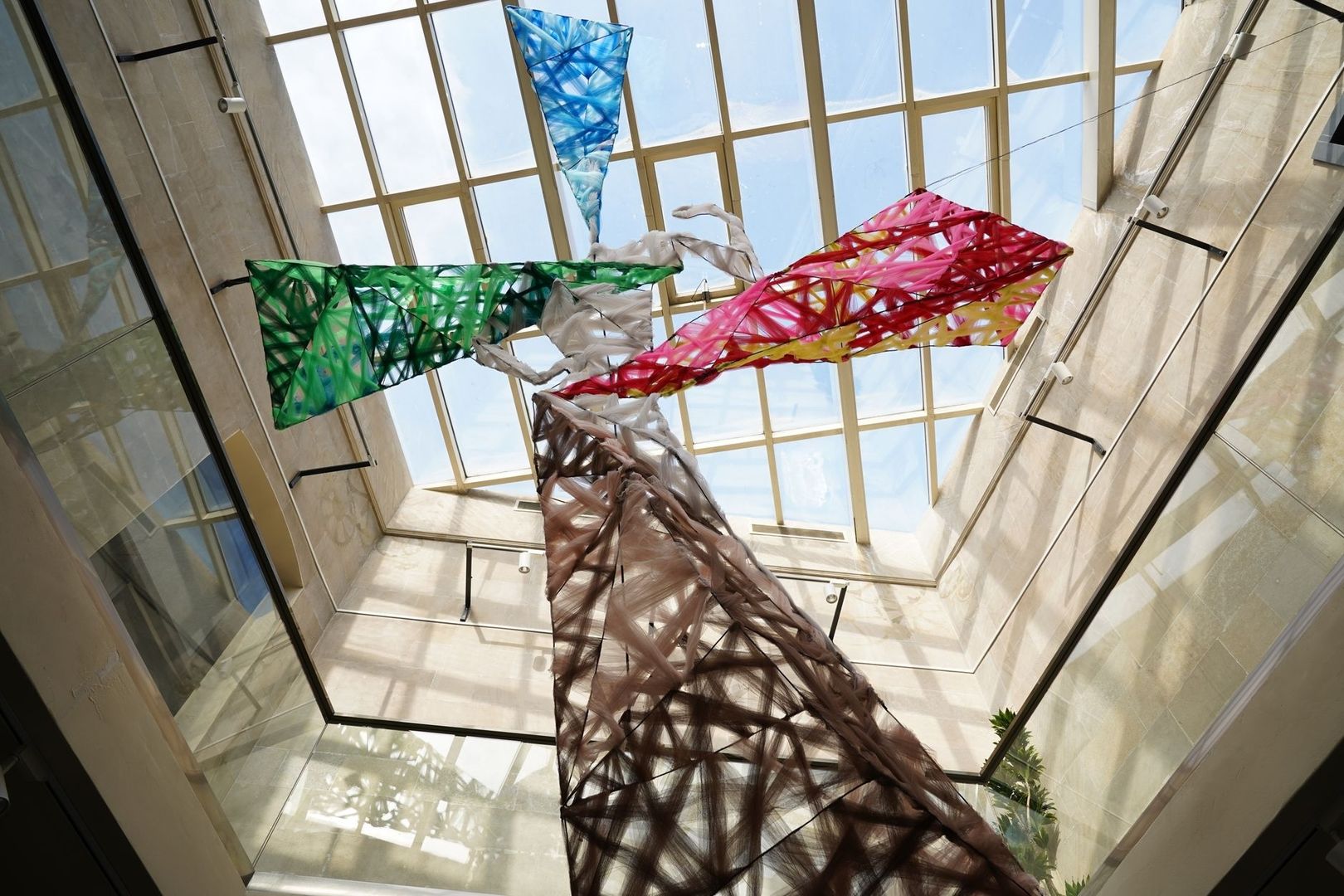
Dimensional fiber is particularly effective because it introduces contrast without creating visual conflict. A relief-like woven band can interrupt a severe wall in much the same way a carefully placed architectural opening interrupts a façade. Its flexibility is visible even when the work is structurally stable, while its accumulated layers create shadows that change throughout the day. This combination of softness and formal discipline allows a textile sculpture to remain richly tactile while still belonging to a highly edited interior.
There is a significant historical precedent for this relationship. During the mid-century period, monumental weavings entered domestic architecture as more than furnishings, often functioning as spatial dividers, architectural focal points, or visual counterpoints to rectilinear construction. The Krannert Art Museum”s account of Dot Replinger”s monumental woven work offers an illuminating example. Her work Sainte-Chapelle, composed of thick, coarsely woven bands, loose ends, and long fringes, was created for the entry hall of a modern home and resonated with the architecture around it. Its saturated colors and layered structure suggested stained glass while retaining the physical gravity of a sculptural textile.
For contemporary open-plan interiors, dense fiber compositions also offer a practical advantage. They can visually absorb and acoustically temper the hard reverberation produced by large rooms with stone, plaster, timber, or glazing. A textile artwork should never be presented as a substitute for professional acoustic treatment, but its layered construction may help interrupt reflected sound, particularly when it projects from the wall or hangs as a screen. This is one reason collectors increasingly consider fiber art as part of spatial planning rather than as an afterthought.
- Wall reliefs provide concentrated texture and establish a focal point without consuming floor area.
- Hanging screens divide a room while preserving light and visual permeability.
- Freestanding fiber sculptures create a slower, more sculptural rhythm around furniture and circulation paths.
- Layered weavings introduce shadow, depth, and acoustic softness where architectural surfaces feel excessively reflective.
Material Mastery and the Resurgence of Contemporary Craftsmanship
The authority of contemporary fiber art rests on technique as much as appearance. Hand dyeing determines how color enters a thread, whether it remains even, mottled, translucent, or deliberately unpredictable. Structural weaving controls tension, density, and the relationship between warp and weft. Surface design may then extend beyond the loom through stitching, knotting, felting, embroidery, cutting, binding, or the attachment of gathered materials. In a resolved work, these processes are not decorative additions; they are the means through which the artist constructs volume and meaning.
Collector perception has consequently shifted. Fiber is no longer confined to the category of domestic craft or functional textile. A large-scale woven work can demand the same attention to provenance, condition, edition status, installation, and artist intent as painting or sculpture. Exhibitions such as “Bound by the High Desert: Contemporary Fiber Art,” presented at El Zaguán in Santa Fe in 2026, demonstrate how inherited techniques and local materials can support ambitious contemporary expression. Tapestry, hand-dyed weaving, Colcha embroidery, wool, plant fibers, and gathered materials become vehicles for investigating place, cultural memory, and transformation.
The field encompasses a broad material vocabulary. Organic fibers such as wool, linen, cotton, hemp, jute, and plant fiber bring differences in softness, resilience, sheen, and aging. Synthetic filaments can offer tensile strength, saturated color, transparency, or a controlled industrial surface. Hand-spun yarns introduce irregularity that records the maker”s pace and pressure. Mixed-material works may combine these qualities, setting a rough, absorbent fiber against a polished filament or a rigid support. For buyers, material knowledge is essential because it informs not only visual character but also installation requirements, light sensitivity, weight, and long-term conservation.
- Hand-dyed fibers often produce nuanced color variation and a surface that rewards close viewing.
- Structural weaving determines the work”s architecture, from compact planes to open, breathing lattices.
- Hand-spun yarns preserve small irregularities that distinguish an authored work from industrial production.
- Synthetic filaments may introduce strength, gloss, transparency, or unusual color saturation.
- Plant-based materials connect contemporary practice to regional environments and inherited craft traditions.
Formal training reinforces the seriousness of this practice. The curriculum described by Haywood Community College”s Professional Crafts Fiber program brings weaving, hand dyeing, stitching, surface design, textile history, portfolio development, and professional preparation into a single studio-based education. Such lineages help explain why exceptional fiber art demands rigorous looking. The apparent simplicity of a repeated strand may conceal decisions about tension, proportion, color sequencing, structural support, and the behavior of the work in changing light.
Curating and Displaying Three-Dimensional Fiber Works
Placement begins with the relationship between the work”s footprint and the room”s circulation. A wall relief requires sufficient breathing space for its shadows to remain legible, while a hanging screen needs clearance on every side and a secure overhead system. Freestanding works should be positioned where they can be encountered from several angles without becoming obstacles. The correct location is rarely the largest available wall. It is the point at which scale, sightline, light, and movement allow the work to exert presence without overwhelming its surroundings.
Consider how each form changes the architecture around it. A compact relief concentrates attention and can bring intimacy to a dining area, library, or entry passage. A vertically suspended textile creates a sense of height and may organize an open-plan room into distinct zones. A low, organic sculpture introduces a grounded counterpoint to tall cabinetry or angular seating. Institutions such as the Denver Art Museum”s Avenir Institute of Textile Arts and Fashion demonstrate the value of treating textiles through curatorial, cultural, and spatial frameworks rather than as a single decorative category. That approach is equally useful in a private collection.
| Textile form | Spatial effect | Best placement consideration |
|---|---|---|
| Wall relief | Creates depth, shadow, and a concentrated focal point | Allow a quiet surrounding field and use secure, material-appropriate mounting |
| Hanging screen | Divides space while retaining light and permeability | Confirm ceiling strength, clearance, and viewing access from both sides |
| Freestanding sculpture | Establishes a three-dimensional anchor within circulation space | Provide a stable base and enough room for multiple viewpoints |
| Layered tapestry | Adds visual warmth and softens expansive architectural planes | Balance its density against furniture, glazing, and existing wall texture |
Pairing is most successful when contrast is intentional. An organic silhouette can sit beside a structured modern chair, allowing the two forms to clarify one another. A restrained palette may be given greater authority through a mineral wall color, while a saturated weaving can be balanced by unpatterned upholstery and disciplined furniture lines. Avoid placing several highly complex textiles in direct competition unless the collection is being curated as a deliberate salon. One commanding work, properly lit and given visual silence, often has greater architectural impact than a crowded arrangement.
Lighting Strategies and Environmental Preservation for Collectors
Light should reveal the construction of a fiber work without flattening its relief. Grazing illumination from the side can emphasize ridges, knots, and projecting loops, while a carefully angled spotlight can cast delicate shadows that become part of the composition. Diffused ambient light is preferable for fragile or highly absorbent materials. Fixtures should be positioned to avoid hot spots, glare, and concentrated heat, with LED sources generally favored for their low ultraviolet and infrared output. The final arrangement should be assessed at several times of day, since a work may appear entirely different in morning light, evening illumination, and darkness.
Conservation begins with restraint. Direct sunlight can fade dyes and weaken fibers, while ultraviolet radiation remains damaging even when the room does not feel warm. Stable temperature and humidity are also important, especially for works combining natural fibers, wood, paper, metal, or adhesive elements. Guidance from Winterthur Museum”s textile conservation advice emphasizes window filtering, suitable glazing, archival mounting, careful dust removal, and avoidance of unstable storage environments such as attics and basements. Any historic or structurally vulnerable textile should be evaluated by a professional conservator before cleaning, washing, or alteration.
- Document the work. Record the artist, title, date, materials, dimensions, provenance, installation method, and current condition before display.
- Choose a stable location. Keep the piece away from direct sun, heating vents, fireplaces, plumbing risks, and areas exposed to repeated impact.
- Install appropriate support. Use professional mounting hardware suited to the work”s weight and construction, rather than relying on improvised fixtures.
- Control the light. Add window filters or specialized glazing where necessary, and angle LED illumination so that relief is visible without creating heat or glare.
- Monitor the environment. Watch for unusual humidity fluctuations, dust accumulation, fading, insect activity, or changes in tension and shape.
- Clean conservatively. Remove loose dust with minimal contact and low suction only when appropriate; seek conservation advice before wet cleaning or repair.
Preventive care protects both material integrity and market confidence. A well-documented work with a stable display history is easier to insure, appraise, relocate, or lend. Collectors should retain invoices, certificates, installation instructions, exhibition records, and high-resolution condition photographs. These practical measures preserve the object while also preserving the story of its passage through a collection.
Building a Living Collection with Enduring Tactile Resonance
Dimensional fiber art captivates because it engages several registers at once. It is image, object, surface, structure, and atmosphere. It can recall an ancient hand process while appearing unmistakably current; it can soften an austere room while maintaining the intellectual discipline of contemporary sculpture. Its shadows are never entirely fixed, and its material presence encourages a form of looking that is slower, closer, and more attentive.
A thoughtful collection can place emerging textile voices in conversation with established studio masters, balancing experimentation with historical depth. When selected for craftsmanship, provenance, scale, and spatial compatibility, fiber works become active architectural participants rather than mere wall decoration. They help a room breathe, absorb sound, guide movement, and hold memory. For collectors and designers seeking an art form capable of meeting the demands of modern interiors without surrendering human touch, the return of tactility offers not a passing fashion but a durable way of seeing and inhabiting space.