
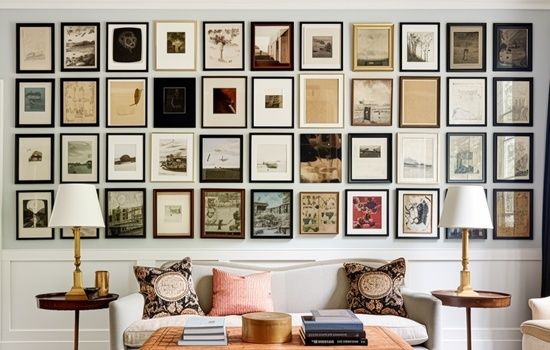
The Art of the Curated Salon Hang
The salon hang emerged in late seventeenth-century Paris, when the French Royal Academy began presenting expansive exhibitions in which paintings were displayed closely, sometimes from floor to ceiling, to accommodate ambitious quantities of work. The effect was opulent rather than sparse, encouraging the eye to move between subjects, frames, textures, and periods. Unlike the modern single-line arrangement, a salon wall treats the architecture as a field for visual conversation, allowing a collection to feel abundant while remaining deliberate.
In a contemporary home, however, abundance can quickly become visual noise. Contrasting eras, ornate mouldings, modern photography, sculptural objects, and small works acquired over time may gather without a clear hierarchy. The transformation from random cluster to intentional focal point depends on more than taste. It requires curatorial balance, disciplined sightlines, considered negative space, and enough structural cohesion for every work to retain its identity while contributing to the larger composition.
Establishing the Anchor Piece and Optical Weight
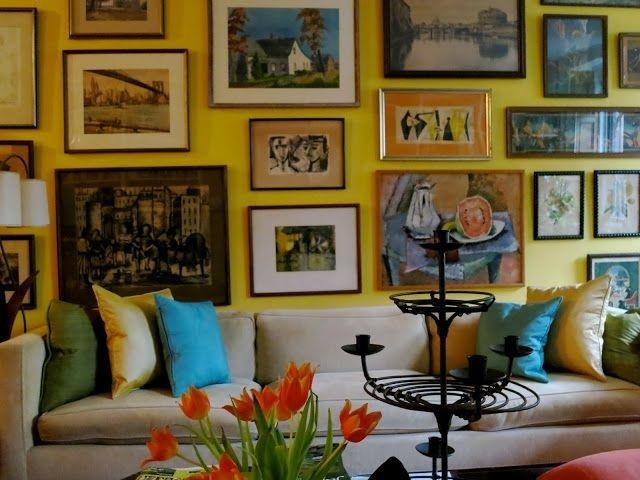
Begin with an anchor that establishes the emotional and visual register of the wall. This may be a substantial oil painting with concentrated pigment, a prominent figurative print, a large photograph, or a tactile relief whose surface catches the light. The anchor does not need to be the most expensive work in the collection. It needs to possess enough scale, contrast, or material presence to give the surrounding pieces a point of reference.
Optical weight is created by more than physical dimensions. A small work with a dense black field, a heavily carved gilt frame, or an intensely saturated palette may carry as much visual force as a larger, pale drawing. Distribute that force across the arrangement rather than allowing dark, oversized, or heavily textured works to collect in one corner. A quieter drawing placed beside a vigorous impasto painting can provide necessary relief, while a slim frame near an ornate one can prevent the composition from becoming top-heavy.
Architecture should participate in the decision. A console, mantel, doorway, or change in ceiling height offers a natural boundary and can help determine whether the grouping should feel compact or expansive. Above furniture, the lower edge of the composition should relate comfortably to the object beneath it, while a broad uninterrupted wall may support a more generous installation. When planning how a dense display evolves across the architecture of a room, this practical salon wall case study offers useful insight into pacing, wall coverage, and the way an arrangement can grow beyond its original plan.
- Choose one primary work before deciding on the outer dimensions of the group.
- Balance dark, saturated, ornate, and three-dimensional pieces across the entire composition.
- Use furniture and architectural features as grounding references rather than treating the wall as an isolated rectangle.
- Leave room for quieter works that provide pauses between visually assertive pieces.
Bridging Disparate Eras and Framing Profiles
Mixed frames become persuasive when their differences appear intentional. An antique carved giltwood frame can sit comfortably beside a minimalist matte-black profile or a slim natural-oak frame when the arrangement gives each enough breathing room. The relationship is strengthened when one attribute repeats elsewhere, such as a warm metallic note, a shared wood tone, or a consistent level of refinement in the frame construction.
Matting is one of the most effective ways to calm stylistic friction. Uniform off-white museum board can give vintage sketches, contemporary photography, and works on paper a shared visual margin. Linen liners introduce a tactile, quietly traditional note, particularly around drawings or historical prints. The following comparison clarifies how different framing strategies influence an eclectic wall.
| Framing approach | Visual effect | Best use |
|---|---|---|
| Uniform off-white matting | Creates a calm, gallery-like field around varied works | Vintage sketches, photography, prints, and works on paper |
| Linen liner | Adds texture and a restrained sense of tradition | Drawings, portraits, historic works, and softly coloured compositions |
| Mixed frame finishes | Introduces collected character without requiring identical mouldings | Salon walls spanning several periods or rooms |
| Simple consistent profiles | Places emphasis on the art rather than the frame | Strongly coloured rooms or collections with especially varied imagery |
Unifying Mixed Mediums Across Common Sightlines
A compelling salon wall should not separate painting, textile, photography, and sculpture into unrelated categories. Instead, each medium can contribute a different kind of rhythm. An impasto oil introduces raised movement and changing shadows; a textile adds softness and absorbent colour; a photograph offers clarity or spatial depth; a shallow relief interrupts the expected flatness of the wall. The result can resemble a cabinet of curiosities, provided the objects share some underlying relationship in palette, subject, scale, or emotional atmosphere.
Spacing is the quiet discipline that keeps this abundance legible. For many domestic groupings, an inter-frame interval of approximately 2 to 3 inches provides proximity without collision. Heavier or more ornate frames may require additional room, while a closely related series can tolerate tighter intervals. Deliberate negative space should also appear within the composition itself. A gap beside a pale drawing can function like a breath in music, allowing the eye to rest before moving toward a more concentrated work.
Common sightlines matter as much as the wall being considered. A gallery visible from an entry hall, dining area, or adjoining room should have a recognisable visual centre rather than presenting every work at equal volume. Historic domestic galleries, including the classic townhouse collections associated with Boston”s architectural heritage, demonstrate how repeated horizontal lines, measured intervals, and carefully chosen viewpoints can resolve complex groupings into refined spatial statements.
- Repeat a colour, subject, material, or tonal value to connect works made in different media.
- Keep most inter-frame intervals within the 2 to 3 inch range, adjusting only when scale or ornament demands it.
- Align selected horizontal edges or optical axes to create invisible architectural order.
- Protect important sightlines through doorways and circulation areas by giving the central works clear prominence.
- Edit when every object competes equally; a salon wall gains sophistication from pauses and variation.
A Step by Step Method for Layout and Precision Hanging
Precision begins before the first nail enters the wall. Measure the available area, note furniture and architectural obstructions, and photograph the wall from the main approaches through the room. Then make kraft-paper templates for each work, marking the frame outline and the position of the hanging hardware. This allows the composition to be tested at full scale without risking unnecessary holes or discovering too late that a door, switch, or moulding interrupts the intended rhythm.
- Identify the anchor and place its template near the visual centre of the proposed arrangement.
- Establish the central sightline, generally 57 to 60 inches on centre from the floor to the heart of the grouping.
- Build outward from the anchor, alternating visual weight, orientation, and medium.
- Maintain approximately 2 to 3 inches between most frames, then widen selected gaps around ornate or unusually dense works.
- Step back repeatedly from the room”s principal viewpoints and assess balance, not merely the accuracy of individual measurements.
- Mark hardware only after the full composition feels stable, then use suitable D-rings, brackets, or sturdy frame fixtures.
The 57 to 60 inch guideline is a starting point rather than an absolute command. A grouping above a deep console may need to rise or compress according to the furniture”s scale, while a floor-to-ceiling salon installation can deliberately extend beyond conventional eye-level logic. The important principle is that the visual heart should feel accessible from the dominant standing and seated positions in the room.
Once mounted, check every work for level and stability. Flush mounting with appropriate hardware often produces a cleaner result than relying on long hanging wires, particularly when frame depths vary. Small silicone dots can reduce movement and protect the wall from repeated shifting. The final arrangement should retain enough flexibility to accommodate future acquisitions, but its initial structure must be sound enough that additions feel like chapters rather than corrections.
Living with an Evolving Collection
A salon wall is best understood as a fluid narrative rather than a static installation. Collections gain meaning through proximity: a portrait may alter the reading of an abstract work, an inherited frame may lend gravity to a contemporary photograph, and a modest drawing may soften an otherwise formal sequence. These relationships can change as light shifts through the seasons and as the room”s furnishings evolve.
Allow seasonal adjustments, new acquisitions, and rotated heirlooms to enrich the story over time. The wall need not preserve its first arrangement indefinitely, and an occasional edit can restore clarity when the composition becomes crowded. Once anchor points, optical weight, negative space, and framing relationships are understood, creative freedom becomes much greater. The result is not merely a decorated wall, but a living room of ideas, material histories, and personal provenance.