
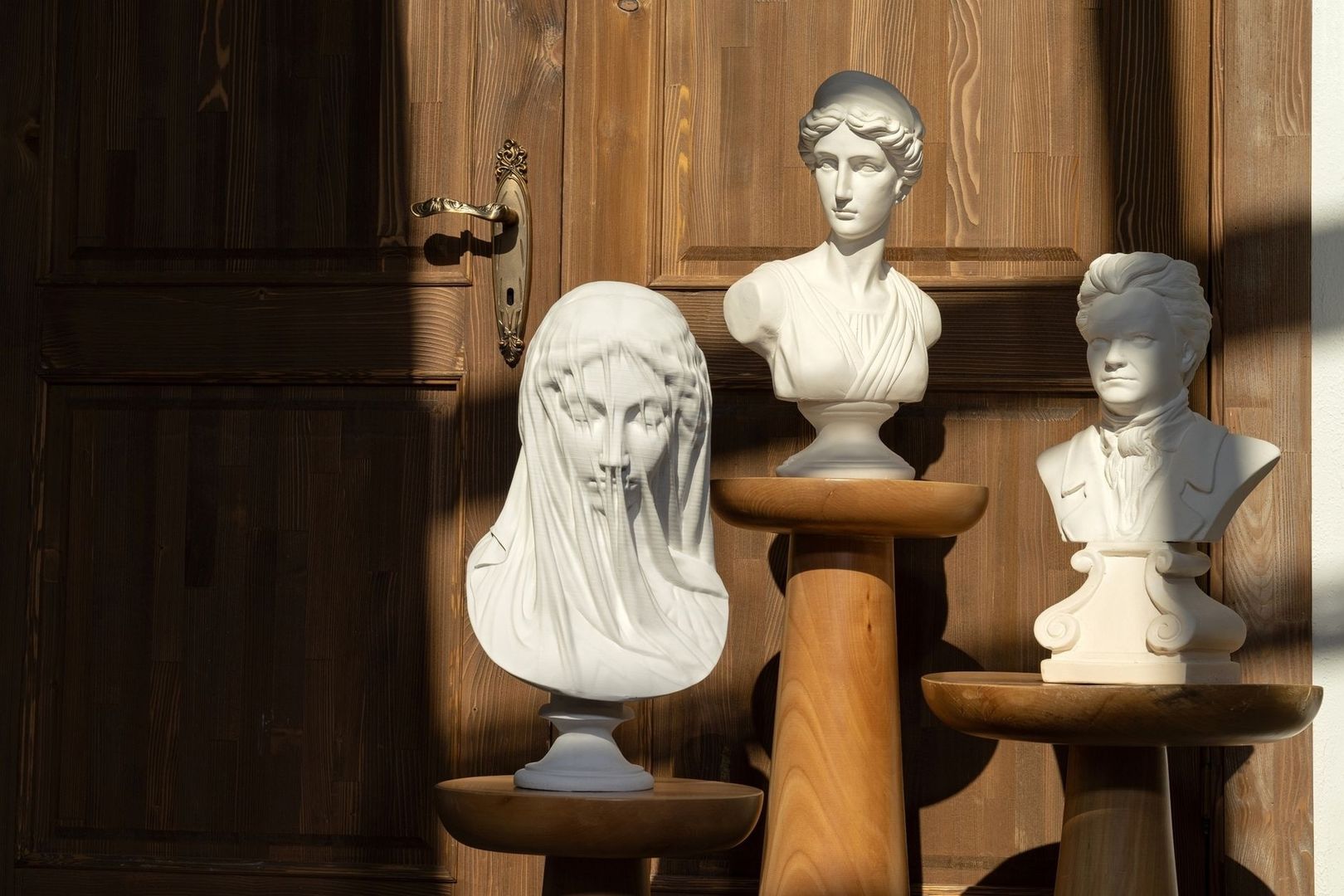
Moving Beyond Flat Walls to Welcome Sculpture into Daily Life
A painting occupies a plane, while sculpture enters the room as a physical presence. Its silhouette changes with every step, its surface records the movement of light, and its relationship with architecture is never fixed. Bringing a three-dimensional work into a home therefore does more than add an accent. It introduces a new participant into the choreography of domestic life, one that can alter how a hallway is crossed, where a conversation settles, or how a room is understood at different hours.
Collectors often approach sculpture with greater hesitation than two-dimensional art. Paintings have an obvious destination on the wall, whereas a sculpture may seem to demand a dedicated gallery, an expansive floor plan, or a formal pedestal. As a result, even exceptional works are sometimes placed in passive corners, beside bookcases, or on surfaces too small to support their visual authority. Such treatment diminishes the very qualities that make sculpture compelling: volume, shadow, touch, and movement.
The more rewarding approach is to treat sculpture as an active spatial dialogue partner. Its placement should respond to circulation, architectural axes, furniture groupings, and changing light. Its pedestal should feel considered rather than incidental, and its illumination should reveal the work”s changing character after sunset. The following principles focus on three essential decisions: creating generous sightlines, selecting a grounding surface with architectural weight, and shaping both natural and artificial light around the object.
Circulation and Sightlines That Let Three-Dimensional Art Breathe
The first question is not where a sculpture can fit, but how it will be encountered. A work intended for three-dimensional viewing should ideally be approached from more than one direction. Even when the artist has established a primary front, the sides and reverse may contain crucial information: the compression of a torso, the joining of two materials, a deliberately unfinished plane, or a shadow that completes the composition. Whenever possible, allow a true 360-degree viewing path rather than pressing the sculpture flat against a perimeter wall.
Transitional spaces are especially powerful. A foyer can establish a collector”s sensibility before a guest enters the principal rooms. A stairwell can give a vertically oriented work a natural architectural counterpart, while a wide hallway threshold can frame a sculpture as a moment of pause between one interior and another. The most successful placements often occur where movement already slows, allowing the work to be seen repeatedly rather than consumed in a single glance. Principles borrowed from sculpture garden exhibitions can help residential collectors think in terms of expansive sightlines, changing approaches, and immersive physical pathways.
Clearance must be generous enough to protect both artwork and viewer. Measure the full footprint, including the pedestal, and consider the arc of doors, cabinet fronts, dining chairs, and coats carried through an entrance. A useful planning checklist includes the following:
- Leave a comfortable passage around the work, especially in foyers and hallways where traffic is unpredictable.
- Keep fragile projections, delicate surfaces, and low plinths outside the reach of swinging bags, furniture, and everyday handling.
- Test sightlines from seated and standing positions, not only from the room”s entrance.
- Confirm that the sculpture will not obstruct emergency routes, heating equipment, vents, or essential maintenance access.
- Use temporary tape or a full-scale cardboard mock-up to assess proportion before moving the actual work.
Selecting Pedestals and Surfaces That Ground the Composition
A pedestal is not merely a support. It establishes the sculpture”s visual altitude, defines its relationship with the floor, and can either clarify or compete with the work. A small object may require a tall, slender plinth that brings its details toward the eye, while a broad or forceful form may need a low, weighty base that allows its mass to remain close to the architecture. Scale should be judged in relation to the room as well as to the sculpture. A delicate object on an oversized block may appear stranded, while a substantial work on a narrow stand can seem precarious.
Material is equally consequential. Honed marble offers a quiet, tactile surface with enough density to anchor a room without the reflective glare of polished stone. Monolithic stone can reinforce a work”s gravity, particularly when paired with cast bronze, dark ceramic, or carved material. Warm timber introduces a softer, more domestic counterpoint and can create a productive conversation with wood sculpture, woven textures, or rooms rich in natural fibers. The ideal pedestal does not imitate the artwork; it gives the work a stable visual field in which its distinct qualities become legible.
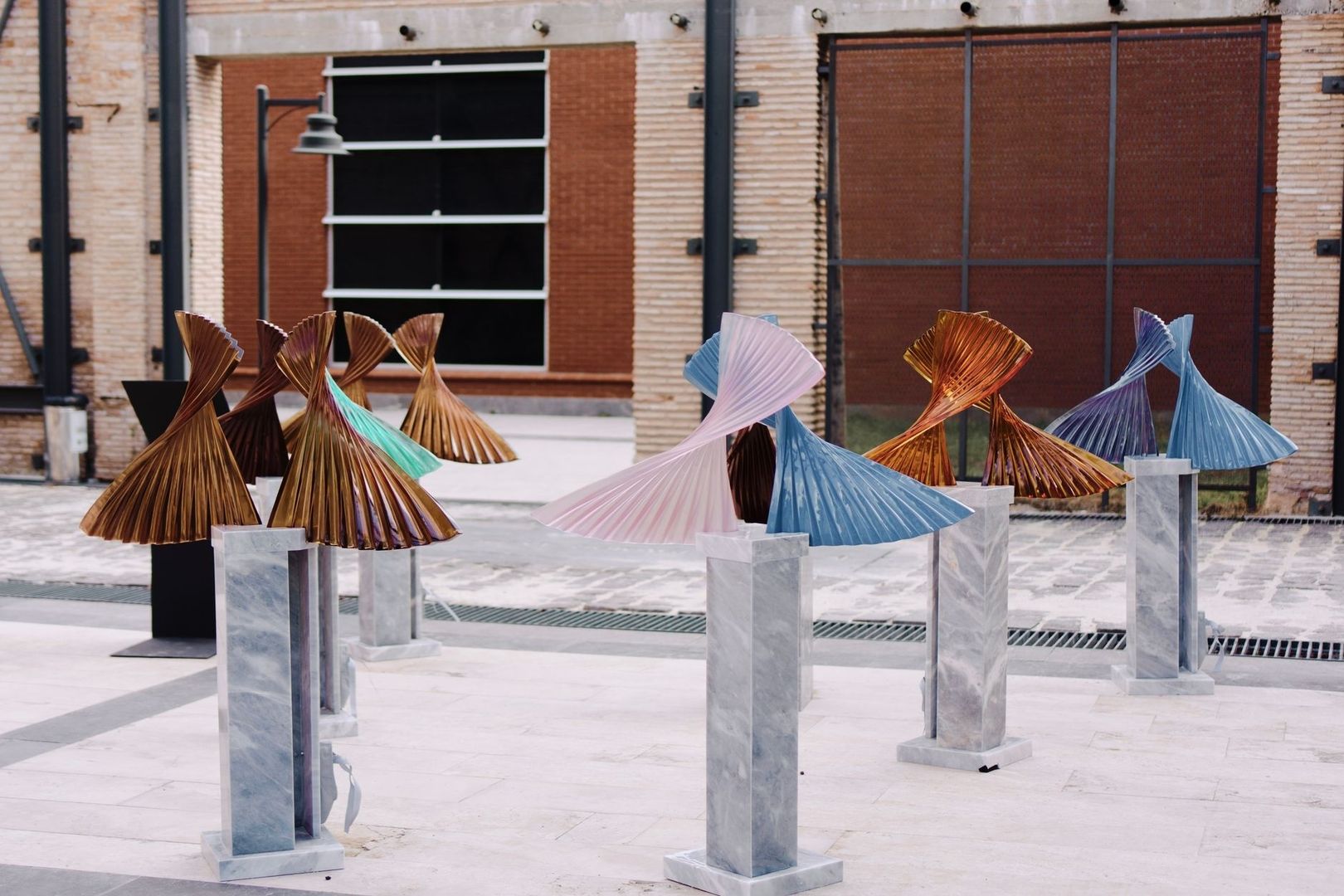
Contemporary plinth designs demonstrate how restrained construction can carry substantial visual weight. The Audo Plinth Pedestal, designed by Norm Architects, uses solid marble slabs and is offered in materials including Nero Marquina, Grey Kendzo, Carrara, Calacatta Viola, and Kunis Breccia. Its listed dimensions are approximately 75 centimeters high, 30 centimeters wide, and 30 centimeters deep, with a weight of 43 kilograms. Such details illustrate an important practical principle: apparent simplicity often depends on considerable mass and careful fabrication.
| Plinth finish | Visual character | Suitable sculptural pairing |
|---|---|---|
| Honed white marble | Soft luminosity and restrained veining | Clay, pale stone, patinated bronze, and finely detailed figurative works |
| Dark veined marble | Graphic contrast and formal depth | Light ceramics, polished metal, and compact abstract forms |
| Warm breccia stone | Earthy variation with a mineral presence | Carved wood, terracotta, and works with warm ochre or rust tones |
| Monolithic stone | Architectural solidity and visual gravity | Large bronzes, rugged stone, and strongly geometric sculpture |
| Warm timber | Domestic softness and tactile continuity | Carved wood, fiber, paper-based forms, and intimate small-scale works |
The Play of Natural Daylight Across Volume and Texture
Natural light gives sculpture a changing life. Morning light may reveal the fine ridges of carved wood, while afternoon illumination can deepen the recesses of clay or draw a narrow highlight across a bronze shoulder. Cast shadows are part of this experience, not an accidental by-product. They extend the work onto the wall or floor and make its presence felt beyond its physical footprint. A sculpture should therefore be observed at different hours before its final placement is confirmed.
Indirect northern exposure generally offers stable, gentle illumination that suits works dependent on subtle modeling. Low-angle golden-hour sunlight provides greater drama, but it can also exaggerate glare, warm a surface unevenly, or accelerate deterioration in vulnerable materials. Historic residential art collections in culture-rich places such as Boston often demonstrate how high ceilings and tall bay windows can create expressive natural shadows, but domestic display still requires conservation awareness.
- Protect dyed, painted, waxed, textile, paper, and other light-sensitive surfaces from prolonged direct sun.
- Use UV-filtering window treatments where strong exposure is unavoidable.
- Keep delicate organic materials away from radiators, fireplaces, and sharply fluctuating heat sources.
- Observe whether sunlight creates a hot spot on metal, varnish, or polished stone during the brightest part of the day.
- Preserve the pleasure of daylight by using calibrated shades or sheer layers rather than sealing the room in permanent darkness.
Curating Artificial Illumination for Nighttime Drama
Standard ceiling downlights are often poorly suited to sculpture. Positioned directly above the work, they can flatten the face of a figure, produce a harsh glare on polished surfaces, and cast shadows downward in a way that obscures rather than describes form. A three-dimensional object benefits from light that arrives with intention. Angled directional spotlights can articulate planes, low-glare wall sconces can create a surrounding field of warmth, and a carefully chosen accent fixture can add an atmospheric layer without competing with the artwork.
Color quality matters as much as direction. A high color rendering index, commonly described as high CRI, helps preserve the difference between aged bronze, lacquered metal, veined marble, and natural timber. A warm-to-neutral correlated color temperature, often in the approximate range of 2700K to 3000K for living areas, can create gallery warmth while avoiding an excessively amber cast. Dimming is essential because the appropriate intensity depends on the sculpture”s finish, the wall color, and the wider room. Decorative lighting can contribute to the composition as well, provided its own silhouette remains subordinate to the artwork.
For an evening arrangement that feels deliberate rather than theatrical, proceed in stages:
- Begin with the room”s existing ambient light and reduce any direct overhead glare that falls vertically onto the sculpture.
- Place one adjustable directional source at an angle of roughly 30 to 45 degrees, then move it gradually until the principal planes and textures become legible.
- Add a restrained secondary source from the opposite side if the first beam creates an overly deep or distracting shadow.
- Use a dimmable wall sconce or indirect fixture to illuminate the surrounding architecture, giving the sculpture a visual context rather than leaving it isolated in darkness.
- Evaluate the work from the main seating positions and circulation routes, checking reflections, glare, and unwanted shadows at eye level.
- Fine-tune brightness and color temperature after the room has been furnished, since pale walls, dark upholstery, and reflective floors all alter perceived intensity.
Transform Your Interior into a Living Spatial Experience
Well-placed sculpture does not simply occupy a room; it changes the room”s rhythm. A carefully chosen position invites the eye to travel around the object, an appropriately weighted pedestal gives it architectural authority, and shifting daylight allows its surface to remain visually active. After dark, layered illumination can reveal another register altogether, turning the work from a daytime landmark into a concentrated source of atmosphere.
Begin with a practical audit of the current interior. Walk through each room at different times of day, note where sightlines naturally converge, and identify corners where sculpture is being treated as storage rather than presence. Measure circulation clearances, test alternative heights with temporary supports, and inspect the work under both daylight and evening illumination. The aim is not to make the home resemble a museum, but to allow tactile forms to participate fully in daily life, where close looking, movement, and changing light give the collection its deepest meaning.